The Trans-Tasman evolution of e-invoicing in Australia and New Zealand

Summary
Australia and New Zealand have developed a unified e-invoicing framework under the Trans-Tasman e-invoicing Arrangement (TTEIA) since 2019.
Both countries use the Peppol network as the foundation for secure, standardized e-invoice exchange.
The region has transitioned to the PINT A-NZ standard, mandatory for all service providers since May 2025.
Initial mandates focused on government capability to receive e-invoices (B2G), now fully implemented
Australia is targeting 30% e-invoicing adoption across federal entities by 1 July 2026, signaling a shift toward active usage.
New Zealand will require large suppliers to send e-invoices to government agencies starting January 2027.
B2B e-invoicing remains voluntary, though Australia is exploring a potential Business E-invoicing Right (BER).
Key benefits include cost reduction, faster payments, improved security, and full automation (STP).
The ANZ region is positioning itself as a globally aligned, Peppol-driven digital trade ecosystem.
The digital transformation of the "ANZ" region is a story of close collaboration. While separated by the Tasman Sea, Australia and New Zealand have moved almost in lockstep since 2019 to create a unified digital trade environment. Both nations have embraced the Peppol network as their common backbone, aiming to move away from the "hidden tax" of manual PDF and paper processing and accelerate government payment times to suppliers.
For readers new to the concept, Peppol is an international network that enables the secure, interoperable exchange of structured documents like invoices and purchase orders directly between accounting systems. Unlike simple digital PDFs, Peppol e-invoices use standards like XML and Universal Business Language (UBL) to allow for automated processing without manual input. To dive deeper into the technical and regulatory aspects of this standard, refer to our comprehensive Guide to Peppol and e-invoicing.
Here is where the road has taken us, and where we are headed next.
The road up until now: a unified vision
Australia and New Zealand officially joined forces on e-invoicing in 2019 under the Trans-Tasman Electronic Invoicing Arrangement (TTEIA). This foundational arrangement, revised in December 2024, is the backbone of the region's digital trade strategy. It established the Australia and New Zealand Electronic Invoicing Board (ANZEIB) to manage governance. The Arrangement's main objectives are to:
Create an interoperable single digital economic market across the Tasman.
Facilitate cross-border trade and streamline transactions, thereby boosting efficiency and reducing business costs.
Improve protections against scams and invoice fraud.
The TTEIA is built upon the Peppol Interoperability Framework, ensuring system integrity and secure electronic document exchange. The initial goal remains: one standard to allow seamless cross-border trade between the two neighbours.
2019-2021: Both governments established Peppol Authorities and began promoting voluntary adoption for business-to-business (B2B) transactions.
2022: The first "hard" requirements arrived. By 1 July 2022, all Australian Commonwealth government agencies were mandated to be able to receive Peppol e-invoices. New Zealand followed a similar path, requiring central government agencies to be capable of receiving e-invoices by 31 March 2022.
(Note for international readers: "Commonwealth government agencies" in Australia refers to the federal, national government entities, distinct from state, territory, and local governments. The unique identifier for Australian businesses is the Australian Business Number (ABN), which is crucial for e-invoicing routing and is referenced in the Peppol network using the 0151 scheme identifier. The ATO, acting as the Australian Peppol Authority (APA), is currently focusing its business-to-government, or B2G, efforts on Non-corporate Commonwealth Entities (NCEs), i.e., federal agencies, to ensure adoption.
For balance, in New Zealand, the B2G efforts are overseen by the MBIE, New Zealand’s Peppol Authority. The unique identifier for NZ businesses is the New Zealand Business Number (NZBN). While the NZBN is the registered business ID, it is typically routed in the Peppol network using the internationally recognised 0088 scheme, the identifier for GLN. Following the initial 2022 mandate for central government agencies, the NZ government will require agencies to mandate large suppliers to send eInvoices from 1 January 2027.)
2023-2024: The focus shifted toward encouraging the private sector. Australia launched consultations on a Business E-invoicing Right (BER), which would give businesses the legal right to demand an e-invoice from their suppliers.
PINT A-NZ: the current technical standard
PINT A-NZ is the new, unified technical standard for the ANZ region. While Peppol BIS 3.0 previously served as the regional framework, Australia and New Zealand have finalised the transition to the PINT A-NZ (Peppol International) specification to enhance global interoperability.
What is PINT (Peppol International Invoice)?
PINT stands for Peppol International. It represents a global family of specifications designed to facilitate the use of Peppol beyond its European origins. PINT specifications are standardised extensions of the core Peppol framework, which is built upon the EN 16931 European standard. PINT aims to provide consistent rules for document exchange while allowing for region-specific adaptations, known as Core Invoice Usage Specifications (CIUS). Other examples of PINT specifications include PINT-SG (Singapore) and PINT-JP (Japan).
PINT A-NZ vs. Peppol BIS 3.0
The PINT A-NZ specification is the next-generation format for the ANZ region. While it maintains the core principles of the former Peppol BIS 3.0, the PINT A-NZ standard provides enhanced data definitions and stricter validation rules specific to Australia and New Zealand's unique tax and business requirements. This includes mandatory use and validation for identifiers like the ABN and NZBN.
Mandatory transition: The PINT A-NZ format became mandatory for all Peppol service providers in the region starting 15 May 2025.
The goal: PINT is designed to improve global interoperability, making it easier for ANZ businesses to trade not just with each other, but with the growing Peppol communities in Singapore, Japan, and Europe.
To understand the foundational technical requirements behind these standards, please consult our detailed article on the EN 16931 Electronic Invoicing Standard.
Regional comparison: core requirements in Australia and New Zealand
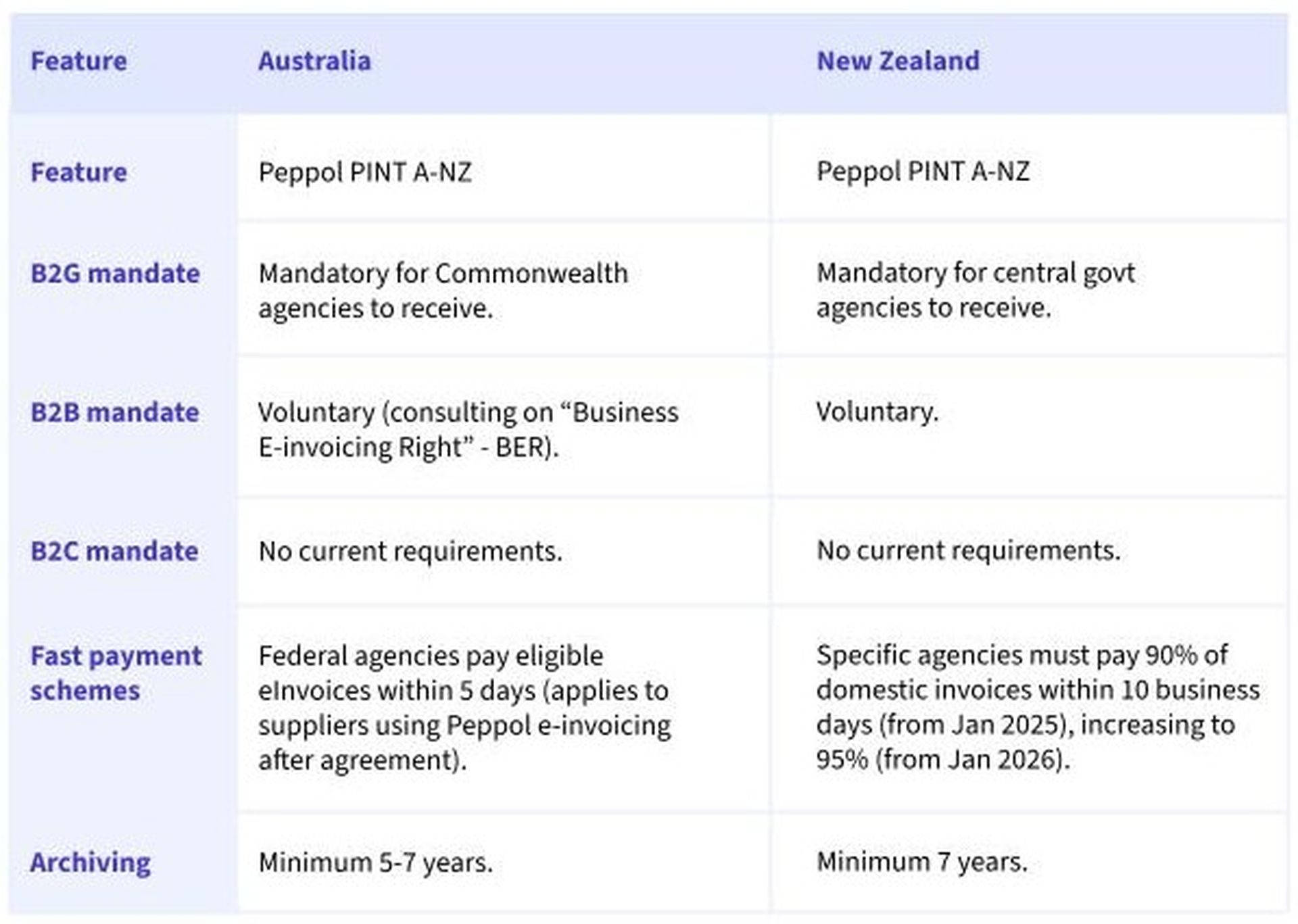
Despite the overarching goal of a single digital market under the Trans-Tasman Electronic Invoicing Arrangement (TTEIA), the e-invoicing landscape in Australia and New Zealand is not entirely identical. While both countries now share the Peppol PINT A-NZ standard, the specific government mandates, payment incentives, and local tax requirements necessitate careful attention to the different modalities outlined below.
What’s next: known, expected, and rumoured
The foundation for e-invoicing is set
The foundation for e-invoicing is fully established. The initial B2G mandates, requiring central government agencies in both countries to be capable of receiving e-invoices, are live, and all participants are utilising the stable PINT A-NZ specification. The next steps focus purely on regulatory expansion and increasing uptake.
Expected regulatory expansion in ANZ
The next phase involves extending e-invoicing reach across government sectors and deepening adoption rates.
Australia (federal B2G expansion)
Building on the 2022 mandate, the Australian Government is actively progressing towards making e-invoicing the default for Non-corporate Commonwealth Entities (NCEs) - federal agencies like the ATO. The Australian Peppol Authority is targeting to:
Achieve 30% e-invoicing uptake across NCEs by 1 July 2026
Enable automated processing/sending by December 2026
State/territory/local governments continue voluntary Peppol adoption on their own timelines. The ATO actively encourages these bodies to adopt e-invoicing and invites them to contact the ATO with any questions regarding their transition.
New Zealand (mandating large suppliers)
New Zealand's immediate focus is on mandating e-invoicing for its largest trade partners. Government agencies subject to the Government Procurement Rules will be required to mandate that their large suppliers send e-invoices when contracting with them, starting 1 January 2027.
Rumoured: the “Business E-invoicing Right” (Australia only)
The concept of the Business E-invoicing Right (BER) has been actively discussed since the government launched consultations in the 2023-2024 period. The BER would establish a legal right for businesses to demand an e-invoice from their suppliers.
While not yet a full "Clearance" mandate like those seen in Europe, the implementation of this right remains a hot topic and is widely expected to be the next major legislative hurdle to drive B2B adoption in Australia.
The commercial advantage of e-invoicing
While mandates drive government compliance, the true long-term value for B2B trade lies in significant operational efficiencies, including but not limited to:
Cost savings: By eliminating paper, printing, postage, and the need for manual data entry, businesses significantly lower administrative costs per invoice.
Enhanced security: Peppol’s four-corner model ensures that all documents are encrypted and exchanged between validated participants, virtually eliminating the security risks and fraud associated with email and PDF invoicing.
Straight-through processing (STP): E-invoices are structured data. This allows them to be automatically routed and ingested by a business’s ERP or accounting system with zero human intervention, drastically reducing internal processing delays, errors, and the associated rework.
Leveraging local expertise
While Australia and New Zealand may sit outside the traditional European regulatory focus, their early adoption of Peppol and strong government backing make them key indicators of how global e-invoicing ecosystems are evolving.
Navigating these shifts requires a partner who understands the local landscape. Having completed the rigorous accreditation processes required to handle sensitive Commonwealth data, Banqup Group is a certified Peppol Access Point in both countries.
By connecting to our network, your business gains a trusted single gateway to navigate the fast-changing ANZ region. Stay ahead of all global and regional e-invoicing developments by following us on LinkedIn and signing up for our newsletter.

Danielle Kiener
Lead Key Account Manager, Banqup Group
Danielle has 15 years of experience in customer relationship management within invoicing and financial administration. She currently works in Geneva, supporting global customers at Banqup Group and helping multinational companies digitise their processes. Over the years, she has been closely involved in the digital transformation of invoicing, including leading e-invoicing initiatives across the EMEA and Asia-Pacific regions for a major multinational. Her extensive experience means she’s always up to date on the latest e-invoicing regulations and changes around the world.